
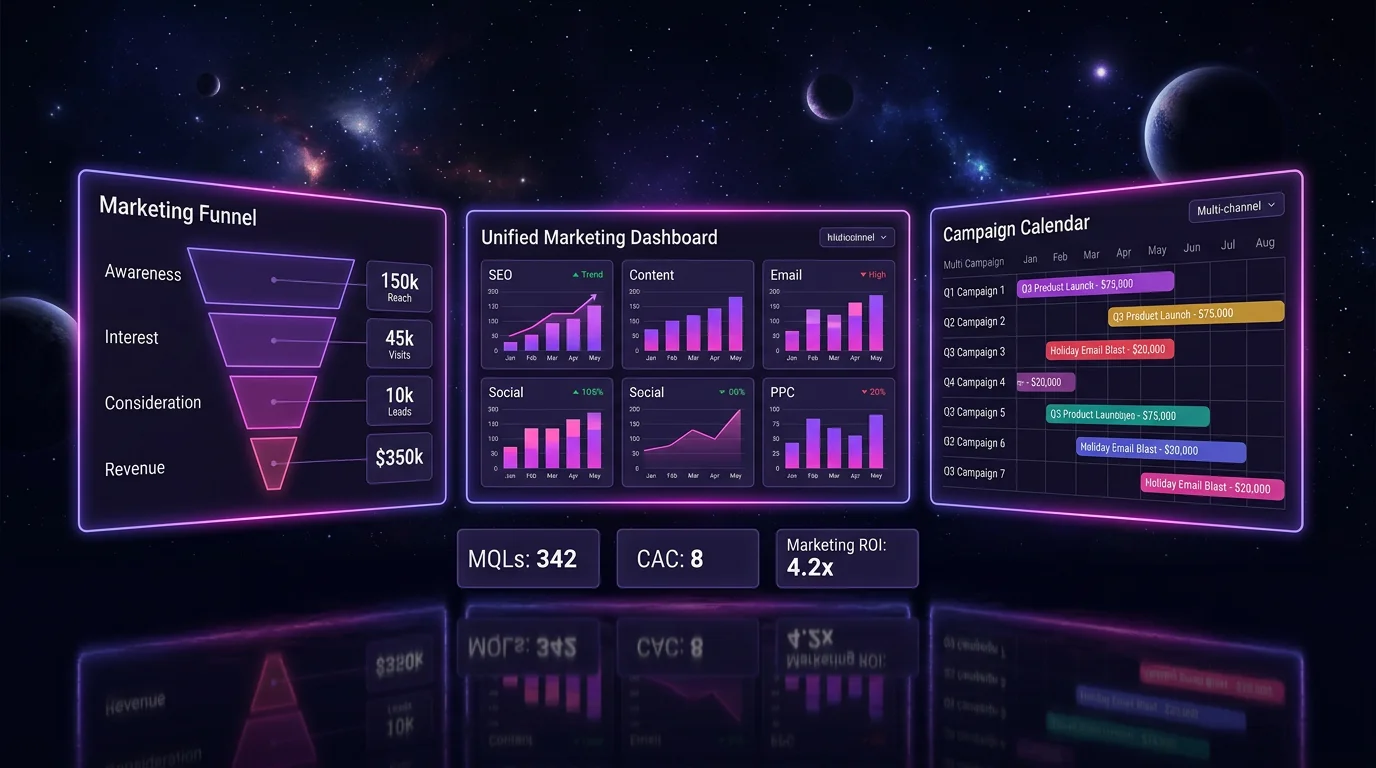
A human marketing team for a growing company typically covers seven roles: a CMO, an SEO manager, a content writer, a social media manager, an email marketer, a paid ads manager, and someone to hold brand consistency. That stack costs $400,000–$700,000 per year in salary — and that's before you count the coordination overhead.
Most founders can't afford that. So they skip most of the stack and do whatever marketing they can personally, at the cost of everything that doesn't get done.
An AI marketing team changes the arithmetic.
Not by replacing the judgment, strategy, or creative decisions that require a human. By handling the execution volume — the weekly SEO audit, the content draft from keyword data, the social queue, the email campaign — that currently isn't getting done because there's no one to do it.
What an AI marketing team actually is
An AI marketing team is a group of AI employees — each holding a specific marketing role — that runs your marketing function on a recurring schedule without needing to be prompted at every step.
Teamday's AI marketing team works this way: Nova, your AI Chief Marketing Officer, agrees one goal with you, and the specialists work against it every week, bringing every draft to you before it ships.
The key distinction from AI tools you've tried before: these are roles, not features.
A chatbot responds when you ask. A writing assistant drafts when you brief it. An AI marketing employee shows up on Monday morning and does the job that role requires — the same way a staff marketer would — whether or not you've logged in.
- Sarah checks ranking positions for your target keywords every week.
- Maya drafts the blog post from the keyword brief Sarah surfaced.
- Luna scans Hacker News and LinkedIn for signals worth engaging.
- Nova writes the next campaign brief based on what moved last week.
That's a team. Not a set of prompts.
The core AI marketing team roles
Nova — AI Marketing Agent (CMO)
Nova owns the marketing function: strategy, positioning, campaign briefs, content calendar, and weekly prioritization — setting what the team works on and tracking what ships.
Nova connects to Ahrefs, Google Search Console, Google Analytics, Reddit, and Hacker News. Every week includes a planning session — what's the one bet this week, what's the measurable deliverable — and a Friday retro on what moved.
Nova is where most founders start if they need someone to own the whole function rather than just execute one task.
Sarah — AI SEO Manager
Sarah runs your SEO operation end-to-end. Weekly performance reports from Ahrefs and Google Search Console, keyword rank monitoring, competitor tracking, content gap analysis, and technical audits.
Sarah identifies quick-win keywords at positions 4–20, spots which pages are slipping and why, and delivers a prioritized action list — not just a data dump. The output is specific enough to act on the same day.
Maya — AI Content Creator
Maya writes from briefs. Hand over a target keyword, audience, and angle — Maya produces a structured draft that incorporates SEO data from Sarah's reports, matches your brand voice, and is ready for a single editorial pass.
Maya's role is to close the gap between "keyword identified" and "article published." Most companies have keyword data but no production capacity to act on it. Maya is the production layer.
→ Hire Maya, AI Content Creator
Luna — AI Social Media Manager
Luna scans social platforms — LinkedIn, Reddit, Hacker News — for signals worth engaging: competitor moves, topic trends, community threads, and distribution opportunities. Luna drafts posts and queues them for approval. Nothing goes live without a human sign-off.
The value is in the surface area Luna covers. Most founders who "do social" manage one platform when they have time. Luna monitors three, surfaces what matters, and has drafts ready before you've opened the feed.
→ Hire Luna, AI Social Manager
Mara — AI Newsletter Manager
Mara manages email end-to-end: subscriber lists, campaign copy, delivery, and performance tracking. Newsletters are drafted from what Nova and Maya are producing — so your email list gets a version of the week's content without anyone writing a separate piece.
Mara connects to Mailgun. Open rates, click tracking, bounces, and list health are part of the weekly report.
→ Hire Mara, AI Newsletter Manager
Echo — AI Brand Voice Manager
Echo holds your brand manual, tone of voice, and messaging guidelines. Cross-channel content gets audited for consistency, posts that drift from your voice get flagged, and copy gets drafted in brand-correct style across platforms.
Echo's job is to make sure that what Nova plans, Maya writes, and Luna posts all sound like the same company.
→ Hire Echo, AI Brand Voice Manager
Markus — AI Ads Manager
Markus monitors paid ad accounts — Facebook, Instagram, and Google — tracking campaign pacing, flagging anomalies, and auditing creative performance. What to pause and what to scale comes back with the reasoning attached.
Markus doesn't make changes without explicit approval. The value is in monitoring the accounts constantly so you catch problems when they're small rather than after you've burned budget.
How an AI marketing team actually coordinates
The CMO (Nova) acts as the coordination layer, setting the weekly priority and briefing each specialist. The specialists run their missions. The founder reviews outputs at two or three decision points per week and handles any judgment calls.
In practice:
- Monday: Nova's planning session — what's the week's priority, what's shipping by Friday.
- Tuesday/Wednesday: Sarah delivers the SEO report. Maya drafts the content piece. Luna's social queue is ready.
- Thursday: Publishing day — content goes live, newsletter sends, social posts approved and scheduled.
- Friday: Nova's retro — what shipped, what moved, what's next week.
The coordination overhead for the founder: roughly 2–3 hours per week. The output: everything that role requires, running on schedule.
AI marketing team vs. a marketing agency
| AI Marketing Team | Marketing Agency | |
|---|---|---|
| Monthly cost | Subscription (fraction of agency) | $3,000–$20,000/month retainer |
| Your business context | Persistent memory, builds over time | Rebriefed each engagement |
| Turnaround | Same-week execution | 2–4 week cycle |
| Ownership | You own the strategy and data | Agency owns the process |
| Specialization | Named agents per role | Account managers handling multiple clients |
| Transparency | Every output reviewable before it ships | Black box until deliverable |
The agency comparison matters because many founders are choosing between the two. Agencies provide human judgment and relationships — valuable for brand partnerships and PR. AI marketing teams provide consistent execution volume that agencies typically don't cover at the task level: the weekly audit, the content draft, the daily social monitoring.
How to build your AI marketing team
Step 1: Start with the function that's costing you the most.
Most founders start with marketing because it's the function that most directly drives growth and is most commonly understaffed. If you have keyword data but no content, hire Maya first. If you have no idea what's working in search, hire Sarah first. If you need someone to own the whole function, hire Nova first.
Step 2: Add specialists as the channels open.
Nova sets strategy. Sarah identifies the keywords. Maya turns them into posts. Luna distributes them. Mara puts them in front of your email list. Each specialist amplifies the previous one. You don't need all seven on day one — but the team scales naturally because each role was designed to hand off to the next.
Step 3: Build the review habit, not the management overhead.
The mistake founders make: treating AI employees like tools they need to micro-manage. The right model is to treat them like you'd treat a capable hire on a 90-day trial. Set a clear deliverable, review what comes back, give feedback on what's off. The feedback loop is what makes the outputs improve over time.
Start with the pre-built marketing team
If you don't want to hire role by role, TeamDay has a pre-configured marketing team: Nova, Sarah, Maya, Luna, and Mara, organized as a unit with defined handoffs between them.
→ See the AI Marketing Team at teamday.ai/teams/marketing
Or if you want to browse individual agents first:
→ Browse all AI employees at teamday.ai/agents
The question isn't whether your business needs a marketing function. It's whether you're going to run it with the people you have now — or deploy a team that ships every week regardless.